
Work · 02
Board game trends: complexity, ratings and the rise of solo play
An interactive dashboard over 31,000 ranked BoardGameGeek games: what drives ratings, how game design has shifted since 1980, and why so many new games now play solo.
- Published
- September 2026
- Built with
- R, DuckDB / SQL, D3, Tableau
I pulled every ranked game on BoardGameGeek (about 31,000 titles with 30 or more user ratings, as of August 2026) along with each game’s mechanism and category tags, and asked three questions: do heavier games really rate higher, how has game design changed, and how fast has solo play grown? Later pulls in October 2026 added crowdfunding tags, designer credits, how spread out each game’s ratings are, player age votes, wishlists and series tags.
Open the interactive dashboard →
What I found
Ratings
Heavier, newer and more popular games all rate higher. Together with genre, those explain more than half of the variation in ratings, so the dashboard also ranks games and designers with those biases taken out. Players disagree most about games built on social interaction.
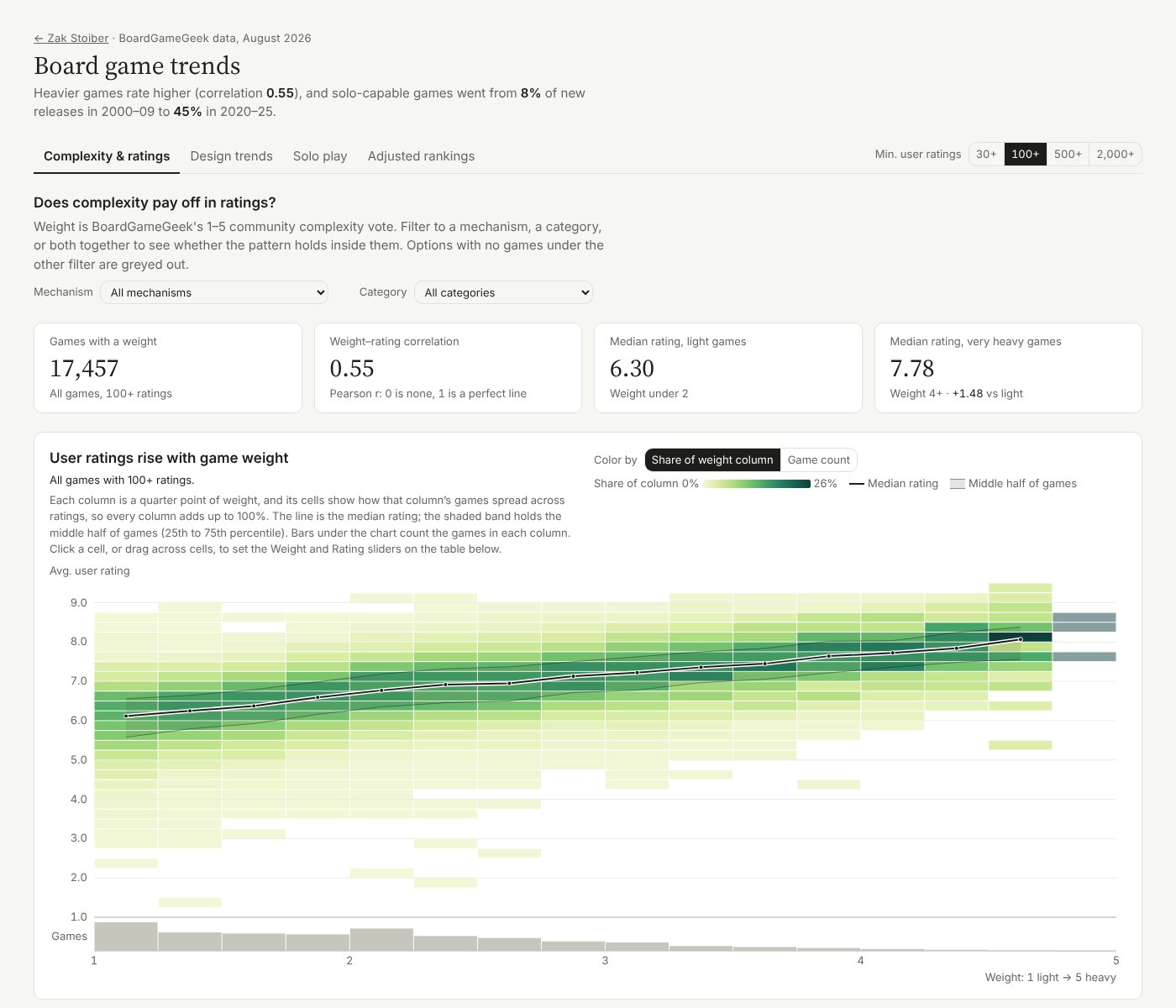
- More complex games rate higher. Weight and average rating correlate at 0.55, and the median heavy game (weight 4+) rates about 1.5 points above the median light game (under 2).
- Weight alone explains 31% of the variation in ratings. Adding release era, number of ratings and genre brings it to 58% (17.5K games with 100+ ratings).
- Interaction splits players. The dashboard’s Divisive column compares how spread out a game’s ratings are with similar games. Games built on role playing, acting, player elimination, hidden roles or voting sit in the top 19–24% for divisiveness. Games built on layering, grid coverage, contracts or worker placement sit in the bottom 27–33%.
- The most divisive hits. Among games with 2,000+ ratings, Unbroken, Cards Against Humanity and Werewolf split players the most. Mid-weight euros like Automania and Glasgow are the ones almost nobody rates a 1 or a 10.
Designers
A designer’s best-known games can beat similar games by more than the rest of their catalog, but experience itself doesn’t show up in the ratings.
- A designer’s hits can beat similar games by more than their catalog does. Reiner Knizia’s typical game rates 0.10 points above games of the same weight, release era, popularity and genre. Weight each game by its number of ratings and he’s at +0.34: his best-known games outperform his long tail of smaller ones.
- Later games rate higher only because they’re newer. For the 657 designers with 10+ ranked games, the median rating climbs from 6.36 on a first game to about 6.7 by the 20th. Against similar games the line is flat: +0.01 for first games and +0.02 for games 21 to 50.
- Designers don’t get heavier, either. Their games average about 2.05 in weight from the first to the fiftieth. Some go much heavier (Dávid Turczi, Uwe Rosenberg) and some much lighter (Corey Konieczka, Vlaada Chvátil), and it cancels out.
Solo play
Solo play went from niche to nearly half of new releases. Complex games led the way, and players say the solo modes hold up.
- From 8% to 45%. 8% of games released in 2000–09 could be played solo. For 2020–25 releases with 100+ ratings it’s 45%, and the jump after 2020 ran well above the earlier trend. The level depends on the floor (39% at 30+ ratings, 55% at 1,000+), because popular games add a solo mode more often, but the rise shows up at every floor.
- More complex games went solo first. In the 1990s, 56% of heavy games (weight 4+) supported solo play, compared with 5–6% of games under weight 2.
- Solo games rose in step with time spent alone, but only in step. The solo-capable share of new games tracks the share of waking time Americans spend alone (American Time Use Survey, 2003–2025) almost exactly: the yearly levels correlate at 0.97. The year-to-year changes barely line up (0.17), though, so I read this as two trends rising over the same years, not one driving the other.
- Players say the solo modes work. For 87% of solo-capable games with 10+ votes in BoardGameGeek’s player-count poll, most voters call 1 player Best or Recommended, and that share hasn’t slipped as solo modes multiplied.
- Solo-capable games rate higher at every complexity level, even comparing only games released in the same years. Most of that gap comes from popularity and genre, though: solo-capable games get more ratings and lean toward genres that rate well. Accounting for both leaves about 0.05 points, and nothing for games of weight 3+.
Crowdfunding
About a third of new games have been crowdfunded each year since 2014. Those games went solo faster and skew more complex, which is most of why they rate a little higher.
- Crowdfunding sped solo up, but didn’t start it. Crowdfunded games added solo modes faster: 62% of 2020–25 crowdfunded releases play solo, compared with 36% of other games. But the crowdfunded share barely moved while solo support nearly tripled.
- Crowdfunded games rate a little higher, mostly because they’re more complex. At the median, 2015–25 crowdfunded releases rate 0.29 points above other games, against 1.48 points between complex and simple games. Compared with similar games, the gap shrinks to 0.02.
Deep cuts
Smaller findings from the October pulls. Their charts are in the dashboard, on Design trends, Complexity & ratings, Crowdfunding and Series.
- Wargames keep to themselves. Hex grids, simulation, dice rolling and grid movement go together however the mechanisms are grouped, and only 2 wargames are also party games, against about 209 if tags were random. Familiar mechanism mixes rate slightly better than unusual ones: 0.09 above similar games, against 0.02 below.
- Players set lower ages for light games and higher ones for heavy games. For 6,418 games with 5+ age votes, players set a younger age than the box 47% of the time and an older one 16%: about a year younger for the lightest games, and more than a year older for weight 4+.
- The most coveted games are often crowdfunded or out of print. Leaving Earth, The Queen’s Gambit and Container are wishlisted the most for each copy owned, and half of the top twelve were crowdfunded.
- 18xx is BoardGameGeek’s biggest series, and close to its heaviest. Its 128 ranked games have a median weight of 3.95 and four-hour play times. They rate well mostly because they’re heavy: only 0.19 above similar games, 40th of 134 series.
How to use the dashboard
The ratings floor at the top (30+ to 2,000+ user ratings) applies to every chart. In the complexity section, filter to a mechanism or category, or drag across the weight chart to narrow the game list. At the end, switch adjustments for weight, release era, popularity and genre on and off to see which games still rate well once those biases are taken out. Show ratings as switches the tables between each game’s rating, its rank among games at the floor (top 5%, say), or both. On Designers and Series, pick or search for a designer or series to see how its games compare with similar games.
Method and data
- Source: the BoardGameGeek XML API, pulled in R.
- Modeling: DuckDB with SQL for the joins and aggregates. The adjusted rankings come from a regression of each game’s average rating on its weight, release era, number of ratings and genre.
- Time alone: my replication of Atalay (2024), using the BLS American Time Use Survey.
- Crowdfunding and solo votes: a second pull from the BoardGameGeek API in October 2026, for each game’s crowdfunding tags, designer credits and suggested-player-count poll.
- Rating spread, ages and wishlists: a third October pull, for the standard deviation of each game’s ratings, the player-age poll and collection counts. Series come from the same family tags as crowdfunding.
- Visualization: first built in Tableau (earlier version on Tableau Public), then rebuilt as this standalone D3 dashboard.
- Download the data: games, game mechanisms, game categories, crowdfunding and solo votes, crowdfunding platforms, game designers, designer names, game series, series names, rating spread, collections and age votes.